Ein bisschen Berlin in a Barrio

posted in: Uncategorised | 0
Three sections of the Berlin Wall sit in a fountain in Berlin Park, Madrid.

I went to see The Berlin Wall: A World Divided exhibition again last week at Fundación Canal. The displays are so in-depth, covering events from the Second World War to present day global divisions, I needed six hours and two visits in total to do it justice!

Before my first visit around Christmas, it seemed appropriate to pop into Madrid’s very own Berlin Park, a few metro stops away in the northern suburb of Chamartin. 

The Foundations

The park was first opened in 1967, six years after the Berlin Wall itself went up, dividing the capital of East Germany into Soviet, French, American and British zones. This physical and ideological barrier separated a country and its people for almost 30 years.

The location of the park was chosen because it was close to the German School and in a neighbourhood with a significant German community, who raised some of the funding themselves. The opening was supposed to coincide with a visit of Willy Brandt, Mayor of Berlin at the time and leader of the Social Democratic Party of Germany from 1964 to 1987 (he later served as the chancellor of West Germany from 1969 to 1974). In fact, he couldn’t make it in the end (he was probably too busy, it was in the middle of the Cold War to be fair) and sent an ambassador instead, who unveiled the granite monolith that still sits in a corner of the park.

The ceramic plaque is a later replacement

Ein bär and un oso

This small monolith, and a nearby bronze statue, both feature bears standing on their hind legs. The bear is a symbol of the city of Berlin and of course, Madrid too. Spanish sculptor Antonio Navarro Santafé created both this Berlin Park bear and the iconic Bear and Madroño tree sculpture in Sol square, right in the centre of Madrid.
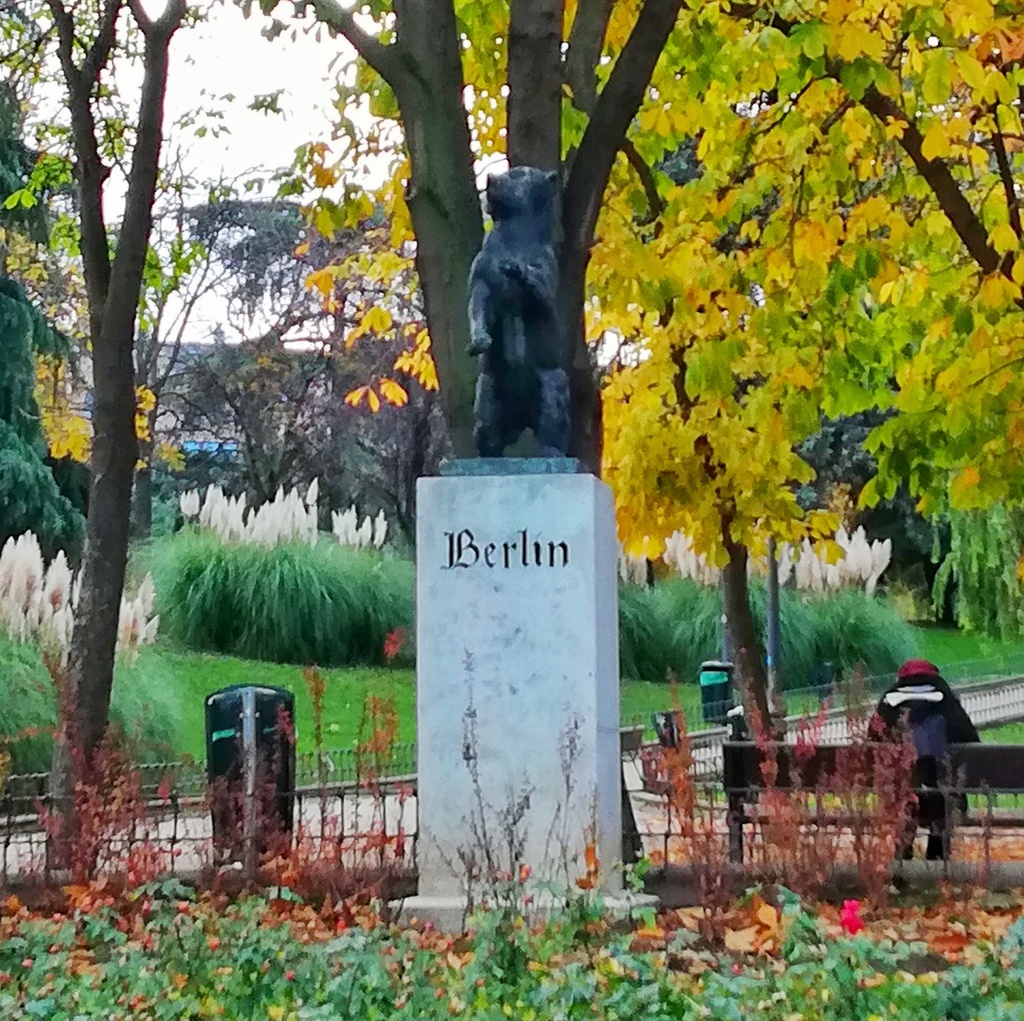
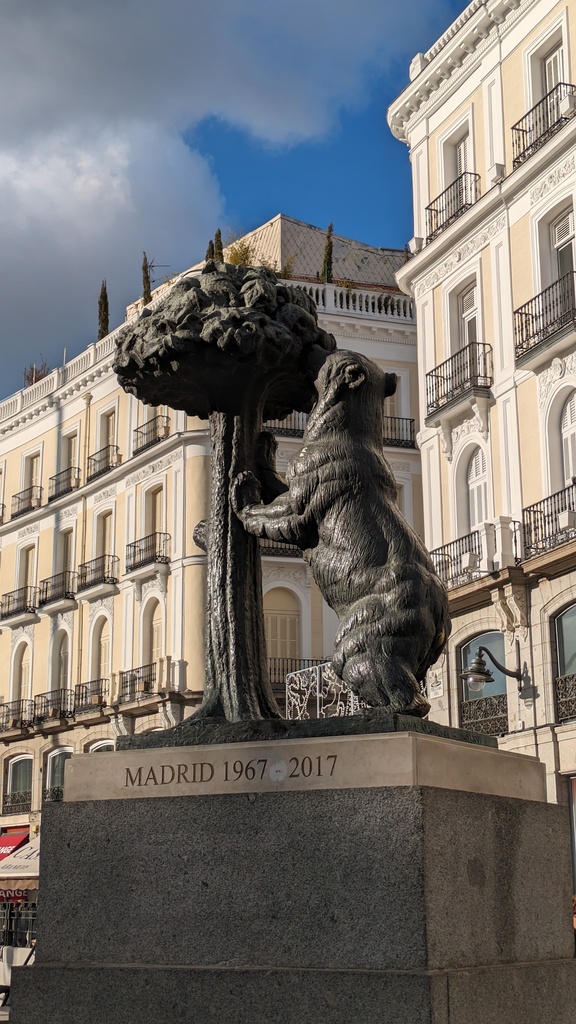
Bear statues in Berlin Park and Sol made by Antonio Navarro Santafé. He also taught at the Madrid School of Ceramics

At this time there seems to have been an increase in friendly relations between Spain and West Germany, with Spain’s stance that the country should be unified. The right-wing Francoist government was super-critical of the Communist eastern block, naturally, and expressed sympathy with the plight of the Berlin citizens, divided by the ‘Wall of Shame’, as Brant had named it. The complex relationship between Spain and Germany in the 20th century is a rabbit-hole to jump down another time, but it is a fascinating one.

Beethoven and the Barrier

The bronze head of Beethoven is by German sculptor Franz Rotter

Even though it’s a park dedicated to Berlin, the ‘other’ German capital hasn’t been forgotten though. From 1949 to 1990, Bonn was the capital of West Germany, and as another symbol of friendship, a monument to Ludwig Van Beethoven (himself born in Bonn) was installed in 1981. A bronze head of the composer sits on a granite piano, carved with the first few bars of his 5th Symphony: the ‘Da da da DAAAH, da da da DAAAH’ bit… 

Three sections of the Berlin wall and a commemorative plaque in a Madrid park fountain.

The main attraction in the park though is the three sections of the Berlin wall itself, positioned in a fountain which was emptied for cleaning when I was there, like many during the winter months. Like 50 or so other cities all over the world, Madrid was gifted a bit in 1990 (they did have 155 km to get rid of) as a commemoration of its demolition a year earlier.

The wall still has the original graffiti, luckily, as apparently an overzealous council employee almost had it cleaned off, and it’s now protected by a special coating. Once an oppressive barrier, the wall now stands as a symbol of the Berliner spirit, no longer dividing a city, but uniting two countries. 

Dos de Mayo: The Madrileñes Strike Back

posted in: Uncategorised | 1

I went to see Ridley Scott’s blockbuster ‘Napoleón‘ last week, expecting to have a little glimpse of his exploits on the Iberian Peninsular. Maybe just a bit, but you know, something.

Well, I was rather disappointed that in the whole movie there isn’t a single mention of Spain. Nope, not a word. Nada. Scott wants to release a four and a half hour version at some point, which I’m hoping may allude to the six or so years the Spanish and Portuguese, assisted by their allies including the British and Irish of course, battled to regain their lands.

In the meantime, I thought I’d add a post from earlier this year, when Madrid hosted a recreation of the fateful events of the 2nd of May, when ordinary Spanish citizens tried to repel the forces of the much stronger and well-equipped army of ‘El Tirano’. Viva!

Lead by Marshal Murat on a gleaming, if rather jittery white horse, two columns of blue-coated soldiers march through the leafy lanes of Retiro Park. They proudly carry two gold eagles and flags bearing the golden N insignia of Napoleon Bonaparte.

Behind them come a band of slightly less official looking Madrileñes. White shirts, espadrilles and straw hats are their uniform. The group includes numerous pitchfork wielding women, who with a couple of priests and a dog, have come to defend their city. 

For one day a year, crowds of onlookers are transported back to the 2nd May 1808. This is an important date in Madrid history, so much so, that it’s still a public holiday. It marks the day when French forces came to expel the royal family and take over the capital. The Spanish army had been told not to resist, but the locals didn’t get the memo. 

Each year, La Asociación Histórico-Cultural Voluntarios de Madrid 1808-1814, reenact a greatest hits tour of Madrid, revisiting the sites that saw ordinary Spanish citizens fighting hand to hand with the well-trained French Grande Armée. 

After marching through Retiro Park, the group lay a wreath to commemorate the fallen at the Monument de Dos de Mayo, near the Prado Museum where Goya’s paintings document the bloody events of the occupation. A volley of musket fire makes the spectators jump, except my boyfriend and I who, as seasoned re-enactors ourselves, are fairly used to it.

The re-enactors then continue on to Puerta de Sol, with the crowd engaging in some light-hearted booing when ‘Vive la France’ is shouted. Now the tourist heart of Madrid, in 1808 this area saw citizens brutally cut down by the curved swords of the Mameluks, a mounted unit made up of various Middle-Eastern and European troops. These days everyone passes peacefully through, past the huge stage erected for the musical events planned for the next couple of days’ holiday. 

I decide I need a drink break in sympathy with the re-enactors who, after 8 hours in wool clothing must be gasping, and after a couple of hours, the reverberating blast of cannon fire alerts me to their return. 

The spectacle ends where it began in 1808, outside the Royal Palace. Angered by the forced removal of the Bourbon family, a group of citizens storm through the gates in the early morning of the 2nd of May. The French are ordered to fire on the crowd without warning, and it is this initial brutal act that leads to the subsequent city wide civilian uprisings. Ultimately almost 400 ordinary Spanish men and women would lose their lives. The recreation ends with this tragic event, luckily these reenactors arise to fight another day after a well deserved rest I hope. 

The events of the 2nd of May didn’t stop the invasion of Spain, it would be another six years before the French would be driven out and Napoleon’s dreams of Empire would be shattered. But their bravery would act as inspiration for the remainder of the War of Independence on the Peninsular and further afield. The Spanish would fight on and that sense of pride still is in the hearts of rebellious Madrileñes 215 years later.

Check out The Making of Madrid blog and this article on a painting associated with the Dos de Mayo uprising.

Mogarraz: Portraits of a Pueblo

posted in: Uncategorised | 2

As you walk through the shady, narrow and steep streets of Mogarraz, faces from the past stare down back at you. This quiet village, sitting over 700 m high within the mountainous Sierra de Francia region of Castile y Leon, has gained some fame in recent years due to a particularly unique art project. 

In 2012 artist Florencino Maíllo Cascón painted portraits of 388 residents who were living in Mogarraz in the 1960s. These images hang on the houses where each person once lived and on the 17th century bell tower of the ‘Our Lady of the Snows’ church. Born there himself, and descended from the town blacksmiths, Maíllo is a painter, photographer, sculptor and Full Professor at the University of Salamanca.

This ambitious project, a record of the past memories of this village, actually originated with some classic Spanish administration. In the 1960s the government ordered everyone of legal age in Spain to get an ID document, with a photo of course. This would have required all the adults to travel to nearby Salamanca, a journey of over an hour each way and a bit of an effort for the more elderly citizens. So, one autumn morning in 1967, in a rare display of local government efficiency, the Mayor of Mogarraz asked local photographer Alejandro Martín Criado to take the pictures himself. A white sheet was hung up in the street and all 388 eligible residents, from farmers to shopkeepers, passed through and posed.

The original negatives were stored in Criado’s house for years, and were largely forgotten until the 1990s, when he asked Maíllo to make a video slideshow for his daughter. The artist (only five years old when the photos were taken) became fascinated by the ethnographic record they represented, and the idea for the painting series was born. 

The portraits themselves are made using an encaustic technique which involves mixing heated wax with coloured pigments, then painted onto wooden boards. This technique, first used by the Romans, gives the faces an antique quality and was a deliberate choice for Maíllo. He links this commemoration of his own ancestors to the way the Romans remembered their dead through highly realistic altar paintings.

These images show a moment frozen in time, a record of a community on one particular day and for Maíllo this creates bitter-sweet memories. The faces are of those who chose to stay in Mogarraz at a time when Spain was experiencing a great population shift. Thirty years into Franco’s regime, villages like this in the rural west were losing their residents to the better wages in industrialised cities like Madrid and Barcelona. On top of this, between 1960 and 1973 over 2 million Spaniards emigrated to France, Germany and Switzerland where demand for labour was high. This decimated rural communities, an effect which is still felt decades later, as you pass the derelict buildings and for ‘For Sale’ signs that litter villages all across the country even today (see my previous post about the village of Belmonte).

The original 388 faces have been joined over the past few years with newer portraits of those who moved away. Today over 800 paintings decorate the facades of the medieval buildings and have become something of a tourist attraction for visitors to the region, drawn to the picturesque villages, natural beauty and famous black ham). For Maíllo this is a double-edged sword, the visitors are a source of income, but the economic development issues that forced many residents to leave in the 1960s have not been addressed. The “bleeding of identity and memory” as he calls it, continues with few opportunities for young people and a reliance on money brought in from outside.

While the past residents of Mogarraz have been brought back together once again, these guardians can only look down and watch, as the future of their village waits to be drawn.

More information about this project and an interview with Florencio Maíllo Cascón see here.

Málaga: A (sort of) river runs through it 

posted in: Uncategorised | 0
The Guadalmedina river looking northwards

A white van is parked under a bridge while two city council workers collect old cardboard boxes, plastic bags and other piles of rubbish. Dog owners let their excited pets off the lead to run around and chase each other. A skateboard park with ramps covered with graffiti sits unused, on this cold Thursday afternoon in February at least. 

I could be describing any park in any Spanish city, right? Actually, I’m talking about a river. 

Flowing down from the Sierra de Camarolos mountains, the Guadalmedina river runs for 47km straight through the city of Málaga, and into the Mediterranean sea. It divides the city into two halves, with the elegant historic centre on its left bank packed with international visitors, even on a windy winter’s day. 

But no-one is coming to the Costa del Sol to admire this natural attraction. In response to frequent and fatal flooding incidents the river was canalised in the mid 20th century to control the water flow. Over the years this piece of well-intentioned engineering has become a source of embarrassment for the local Malagueños, who have called it a ‘scar’ and ‘eyesore’ in the articles I’ve read. You can’t blame them for feeling a bit ashamed, channels of murky looking water are surrounded by wild shrubbery, scruffy, cracked and grafittied walls and piles of rubble. This gives the whole area an atmosphere that’s both dubious and a bit sad, totally in contrast to the lively, friendly and well-maintained city centre.

The river is basically now a concrete channel filled with with rubble and wild plants

But there is a ray of hope. In January 2022 the Andalucian local government announced a 7 million Euro project to redevelop this long neglected river area. The new project, named ‘Water and Life’, is organised in a number of stages. The first phase, to be completed in 2023, involves creating 5km of new accessible paths and lighting installations, along with planting over 5000 new trees and shrubs along the northern section of the Guadalmedina valley. The river part should look like, well, a river and not a storm drain, with a natural flow that can be controlled safely in a region that still suffers from flash flooding. Only one year ago, a woman had to be rescued by firefighters after being trapped in the usually dry riverbed. Every first Wednesday of the month, the Limonero reservoir upstream opens its flood gates for routine maintenance, and the subsequent torrent of water trapped the unsuspecting walker.

The water flow is usually confined to side channels, with the centre section used as a path

I really hope that this new park can be as successful and popular as the Madrid Rio Project that I frequently write about. That project has shown that a carefully thought-out redevelopment, with the right mix of greenery and usable public spaces, can be a real asset for a city. It could also learn from that project’s failings too. For example there are currently no plans to have separate cycles lines along the Guadalmedina, an error that I lament every time I walk (or cycle) along the Manzanares. The area will also need to be publicised to tourists too, with adequate information and signage from the city centre, something that Madrid’s council has yet to achieve in my opinion!

Keeping an eye on this project gives me a great excuse to visit Málaga again anyway, as does eating some espetos: the famous sardines on a skewer cooked on a fire on the beach. It was too windy when I went…